
The Alcazaba of Almería: The Great Citadel
Ten Centuries of History on the Seafront
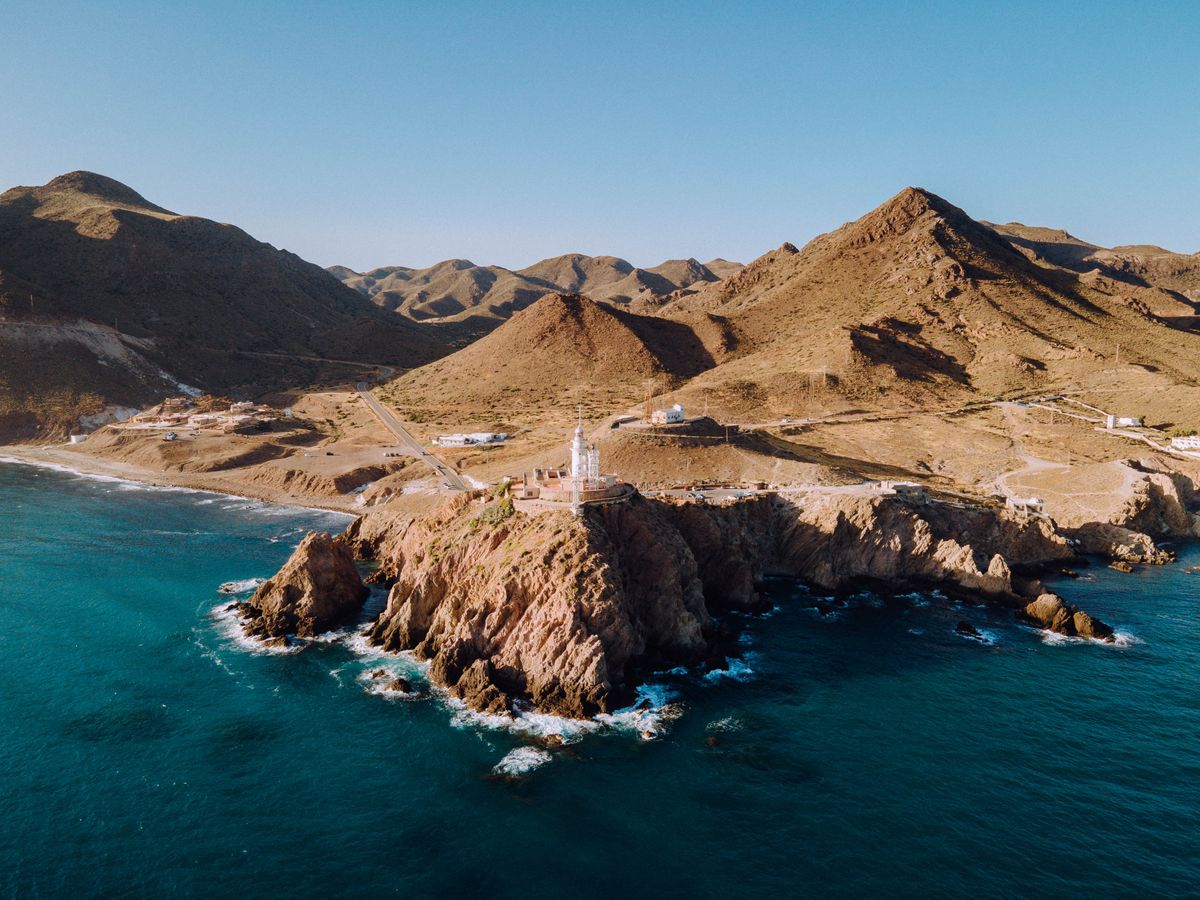
There are monuments that hit you when you least expect them. The Alcazaba of Almería is one of them. Most people come to Almería for the beaches — Cabo de Gata, the crystal-clear water, that sea that seems less Mediterranean than some invented Caribbean — and the fortress sits up there, silhouetted against the Cerro de San Cristóbal, waiting. When you finally climb up, you understand why it has stood here for over a thousand years.
It is the largest Islamic fortress in Spain after the Alhambra in Granada. That is no small thing. And yet it appears on few lists of essential Andalusian sights, which makes it one of those monuments you can visit without queues, without the crush of tour groups, almost in solitude if you’re lucky with the day.
The Arabs Who Looked Out to Sea
The story of the Alcazaba of Almería begins with Abd al-Rahman III, the Caliph of Córdoba, who ordered its construction in the year 955. The city already existed — the Romans called it Portus Magnus, the great port — but it was under Umayyad rule that Almería became one of the most important trading ports of the western Mediterranean.
Abd al-Rahman III did not build here by chance. The Cerro de San Cristóbal dominates both the bay and the land approach to the city. From the top of the walls you can see everything: the ships coming in laden with silk, the merchants criss-crossing the lower town, the bald hills stretching northwards. It was a perfect strategic position.
The original fortress was primarily military: a system of walls, watchtowers, and a small mosque for the garrison. The defensive core that Abd al-Rahman raised — the first enclosure, the oldest one — can still be walked through today, though heavily transformed by later remodelling.
The Great Expansion: Hayran and the Taifa Kingdoms
The most fascinating period of the Alcazaba comes when the Caliphate of Córdoba disintegrates at the beginning of the 11th century and Almería becomes an independent taifa kingdom. King Hayran al-Amiri, who ruled between 1014 and 1028, transformed the citadel into an authentic palace-city within the city.
Hayran expanded the enclosure, added new palaces, built gardens, and turned the fortress into a centre of power and culture. Almería at that time was a wealthy city: the Almerian silk industry exported fabrics across the Mediterranean basin, and that wealth showed in the architecture.
The second enclosure, the largest of the three, is the legacy of this period. This is where you’ll see the remains of the Arab gardens, the cisterns that supplied water to the citadel — you had to fill the reservoirs because in a siege water was the first thing to run short — and the ruins of the dwellings occupied by the soldiers and craftsmen who lived within the walls.
One thing particularly grabs your attention as you walk through the second enclosure: the sheer scale of it. This isn’t a compact fortress of the kind you can walk around in forty minutes. This is a miniature city, with its own neighbourhoods, its public spaces, and its private quarters.
The Catholic Monarchs and the Third Enclosure
The Alcazaba fell into Castilian hands in 1489, when the Catholic Monarchs completed the conquest of the Nasrid kingdom of Granada. For Isabella and Ferdinand, Almería was a strategic stronghold: the most important port on Andalusia’s Mediterranean coast.
The fortress’ new masters did what the Reconquista victors tended to do with Islamic buildings: adapt them to their own military needs. They built the third enclosure, the most recent of the three, in a late Gothic style. Architecturally it’s less interesting than the two earlier ones — Castilian austerity versus Andalusian ornamentation — but it has its own defensive logic: the square towers and thicker walls were a response to the artillery that was already transforming medieval warfare.
The castle of the Catholic Monarchs occupies this third enclosure. What survives is well restored and from its viewpoints you get one of the best views in Almería: the modern port, the city stretching westward, the bay with the Sierra de Gádor closing the horizon.
An Earthquake That Changed Everything
In 1522, a devastating earthquake shook Almería. The chronicles of the time describe the city in ruins: several thousand dead, whole buildings collapsed, the port severely damaged. The Alcazaba suffered badly. The second enclosure, which housed the Arab palaces, was so damaged that it was never fully rebuilt.
Over the following centuries, the fortress lost its strategic importance. Almería ceased to be the great port it had been in Islamic times — the trade routes shifted, the Americas changed everything — and the Alcazaba became what many monuments become when they stop being useful: a place where poor people settled temporarily, where things were stored, where vegetation gradually reclaimed the stone.
The modern recovery of the monument came in the 20th century, when archaeological excavations began along with the consolidation and restoration work that has made it visitable today in good condition.
How to Visit the Alcazaba: What No One Tells You
Technically you can visit the Alcazaba in two hours. In practice, if you have even the slightest interest in history, budget three. The second enclosure is where you’ll spend the most time: you have to walk through the reconstructed gardens, the cisterns, the remains of the dwellings, and you have to climb the towers to understand the spatial layout of the whole complex.
The route has some particularly good spots. The main cistern in the second enclosure is one of the largest surviving from Islamic times in Andalusia: a vaulted chamber capable of holding thousands of litres of water, cool and dark, which today also serves as a temporary exhibition space. The contrast between the outside heat in summer and the interior temperature of the cistern is one of those small physical pleasures you don’t forget.
Another point you should not skip: the viewpoints of the third enclosure, especially the one overlooking the La Chanca neighbourhood. From there you can see the blue and whitewashed houses on the hillside, the port, the sea. It’s an image that doesn’t look like western Europe.
Regular opening hours (always confirm before going, as they may vary):
- Tuesday to Saturday: 9:00 to 20:30 (summer hours), 9:00 to 17:30 (winter hours)
- Sundays and bank holidays: 9:00 to 15:00
- Mondays: closed
Admission price: European Union citizens with a national ID or EU passport: free entry. For everyone else: standard price (check the official website). It’s one of the Andalusian monuments with a free-entry policy for Europeans, which should be more widely known.
How to get there:
- On foot from the centre: 15–20 minutes uphill along Calle Almanzor. There are free escalators that make the climb easier.
- By bus: city bus from the centre (Alcazaba stop).
- By car: there is nearby parking, though in high season it can be full.
What to See Near the Alcazaba
The Alcazaba is not the only reason to climb the Cerro de San Cristóbal. Next to the fortress is the Hermitage of San Cristóbal, with even wider views, and if you go down the opposite side from the historic centre you reach the La Chanca neighbourhood, an old area with bags of character and some bars where tourists haven’t yet arrived in droves.
In Almería’s historic centre, ten minutes’ walk from the Alcazaba, stands the Cathedral of Almería, an unusual building: it looks like a fortress because it was also built with a defensive function, with towers and walls, to protect the population from the attacks of Barbary pirates that ravaged the coast in the 16th century. It is the only example in Spain of a cathedral-fortress, and that alone makes it worth a visit.
The Archaeological Museum of Almería rounds off the historical tour: it has an extraordinary collection on the Los Millares culture, one of the most important Copper Age civilisations in western Europe, which flourished in the province four thousand years ago. For anyone coming with a historical interest, the Alcazaba–Cathedral–Museum combination makes a full day.
And then there are the beaches. Cabo de Gata is about forty minutes from the city and has some of the best beaches in the entire Spanish Mediterranean: hidden coves, black or white sand depending on the area, water with no murkiness. To get to the cape, a car is best.
Why It’s Worth It Even If You’re Not a History Buff
I have friends who systematically skip historical monuments. They’re the sort who, in a city like Rome, head to the Campo de’ Fiori market and sit at a terrace while the rest queue for the Colosseum. The Alcazaba works for them too, because the site has something that goes beyond historical interest.
The reconstructed gardens of the second enclosure are well maintained. In spring, with the orange trees in blossom and roses opening, a walk through the gardens is genuinely pleasant regardless of the heritage value of the complex. The views from any point along the walls are spectacular. And the combination of light, stone, and silence — if you go in low season or first thing in the morning — has something meditative about it.
The Alcazaba is not the Alhambra. It doesn’t try to be. It’s a rougher monument, less restored, closer to what it was than to what it was imagined it might have been. That, in my view, is a strength.
Find places to stay in Almería
Compare hotels, apartments, and stays with free cancellation on many bookings.