
The Generalife: The Sultan's Garden
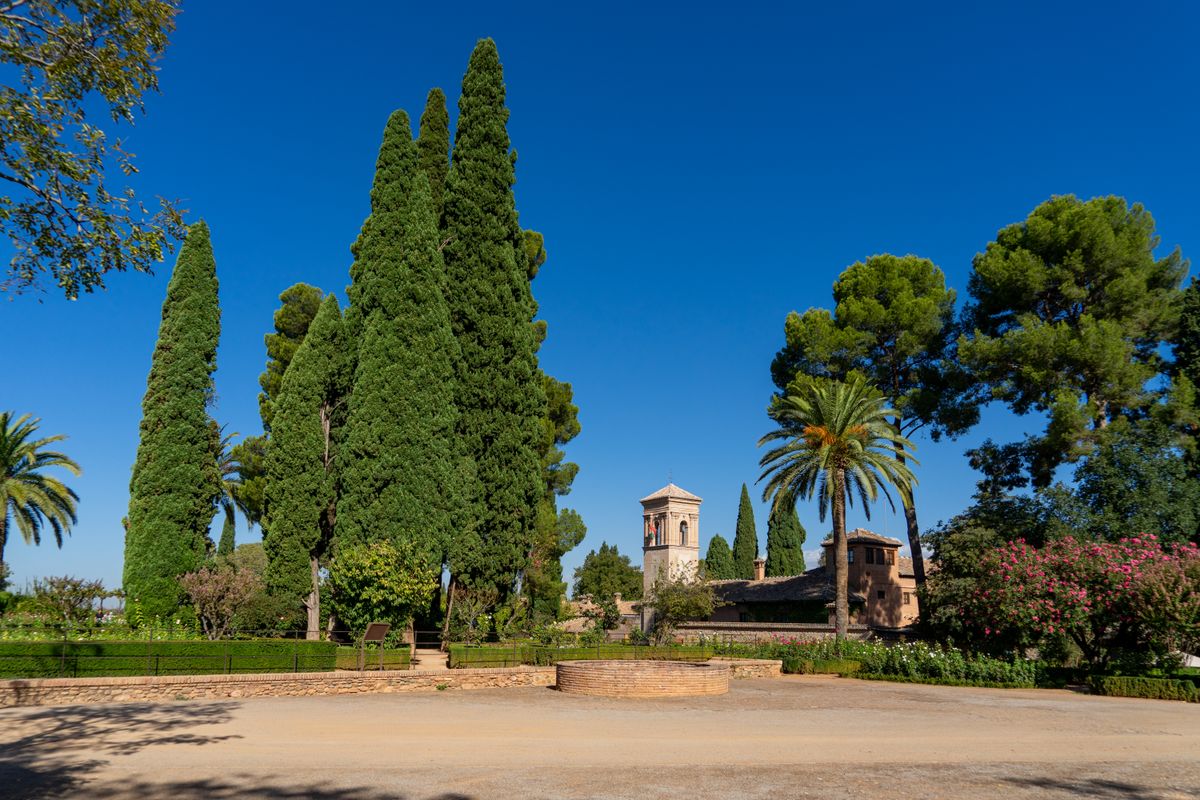
It’s true that towards the end of their time in al-Andalus the sultans had quite a few matters to attend to and needed somewhere to escape the day’s troubles. But when the Generalife was commissioned back in the 13th century, during the reign of the second Nasrid sultan Muhammad II, things were going rather well. Which gives us a clear idea of what it was meant for: a country estate, a place for leisure and relaxation.
The Generalife was built as a rural villa with orchards and gardens where the sultans and their retinues would go to reflect and stroll. Although the Nasrids had large country estates across al-Andalus, this one — thanks to its proximity to the palace-city — would be the favourite of most.
The Name: Royal House of Happiness
Although the name comes from Yannat al-Arif (the house of the master builder or architect), we prefer to call it what the poet-vizier al-Yayyab did: the Royal House of Happiness. The phrase the most sublime garden was also used, which clearly reveals what was intended and what was undoubtedly achieved.
On the outskirts of the Alhambra walls, on the Cerro del Sol, what we see today as incredible palaces was once an agricultural estate and a place of leisure rolled into one. At one point it had up to four separate farms that are still cultivated using traditional methods, thanks to the Acequia del Rey, the same water channel that supplies the Alhambra.
The Generalife is many things: courtyards, palaces, gardens. But above all it is an elegy to water and its relationship with the land and the buildings.
A curious detail: there was only a small path linking the Generalife to the Alhambra, reserved of course for the sultan. The main entrance was via the Cuesta de los Chinos, at the end of what is now the Paseo de los Tristes. They sought privacy: they could see their palaces nearby but a ravine kept them apart. So much so that Muhammad V, the great reformer of the Alhambra, was at the Generalife when he was warned of a plot against him — which allowed him to flee and later return to impose his rule.
A Mirror of the Albaicín
As if it were a reflection, the Generalife echoes the cármenes of the Albaicín: terraced courtyards, retaining walls on the hillside, and whitewashed walls. Every corner surprises with its seclusion, creating an intimate space within a large garden.
Its unmistakable hallmark is the two palaces separated by the Court of the Water Channel, crossed by a beautiful long pool with fountains. If you are lucky enough to walk through this courtyard on a day without too many visitors, a journey back in time is guaranteed.
Entering from the Alhambra you reach the Disembarkation Yard or Stable Yard, with a bench that helped riders dismount. After passing through the guard’s gate, a steep staircase leads to the Court of the Water Channel.
The Court of the Water Channel
It is perhaps the most beautiful and famous part of the whole complex. It follows the typical square Andalusian courtyard layout of Persian origin, but here it was lengthened to increase the size and beauty of the pool. The Royal Water Channel passes through this courtyard — you can see it along one side — carrying water to every part of the Generalife, its orchards and gardens, and also to the Alhambra.
Here’s a small disappointment for many, though it detracts nothing from its beauty: the spectacular fountains whose water jets criss-cross in mid-air, so often the romantic image of these palaces, were added in the 19th century.
It’s worth remembering that the Generalife was conceived as a villa for relaxation and rest, with agricultural work. Beyond this courtyard lies the Royal Chamber with its typical carved plasterwork and an impressive wooden ceiling, but the whole complex was intended as something modest. For sumptuous palaces they already had the Alhambra. Here the sultans sought intimacy, and so its beauty is born of simplicity.
The Water Staircase and Other Secrets
Moving on you reach the Court of the Sultana’s Cypress, where legend has it that Boabdil’s wife had her trysts with a lover who happened to be a relative of her husband. It seems that this was once the site of the palace hammam, demolished by the new Morisco owners to conceal its Islamic past.
And then there is one of the most ingenious solutions in the complex: the Water Staircase. The Arab architects channelled water from the Royal Water Channel along the handrails using roof tiles, negotiating the slope without interrupting the flow. Once again, as throughout the Generalife, necessity becomes virtue.
This staircase leads to a romantic 19th-century viewpoint built over a Muslim oratory, and then to the Oleander Path, where you can see the Moorish myrtle, which together with the common myrtle is the most characteristic plant of the Alhambra.
We could go on detailing every corner of this palace, a World Heritage Site since 1984, but the Generalife — like the Alhambra, like Granada — is more than incredible architecture: it is a feeling you must not leave without experiencing.
Frequently Asked Questions
Is entry to the Generalife included with the Alhambra ticket?
Yes, the general Alhambra ticket includes access to the Generalife. There is also a specific ticket for the Generalife and gardens only, if that’s all you wish to visit.
How long does it take to go around the Generalife?
The Generalife takes between 45 minutes and an hour. If you enjoy gardening or photography, allow a little longer. The upper gardens and the cypress walk invite you to linger.
What makes the Generalife different from the Alhambra?
The Alhambra is a fortified palace-city; the Generalife is a leisure villa with orchards. The Alhambra dazzles with its monumental scale; the Generalife seduces with its intimacy and its gardens.
Related Articles
- The Alhambra, the Red Castle — Complete history of the Nasrid monument.
- Granada — City guide: Albaicín, Sacromonte, tapas, and more.
- Medina Azahara — The palace-city of Abd al-Rahman III in Córdoba.
Find places to stay in Granada
Compare hotels, apartments, and stays with free cancellation on many bookings.