
The Alhambra: The Red Castle
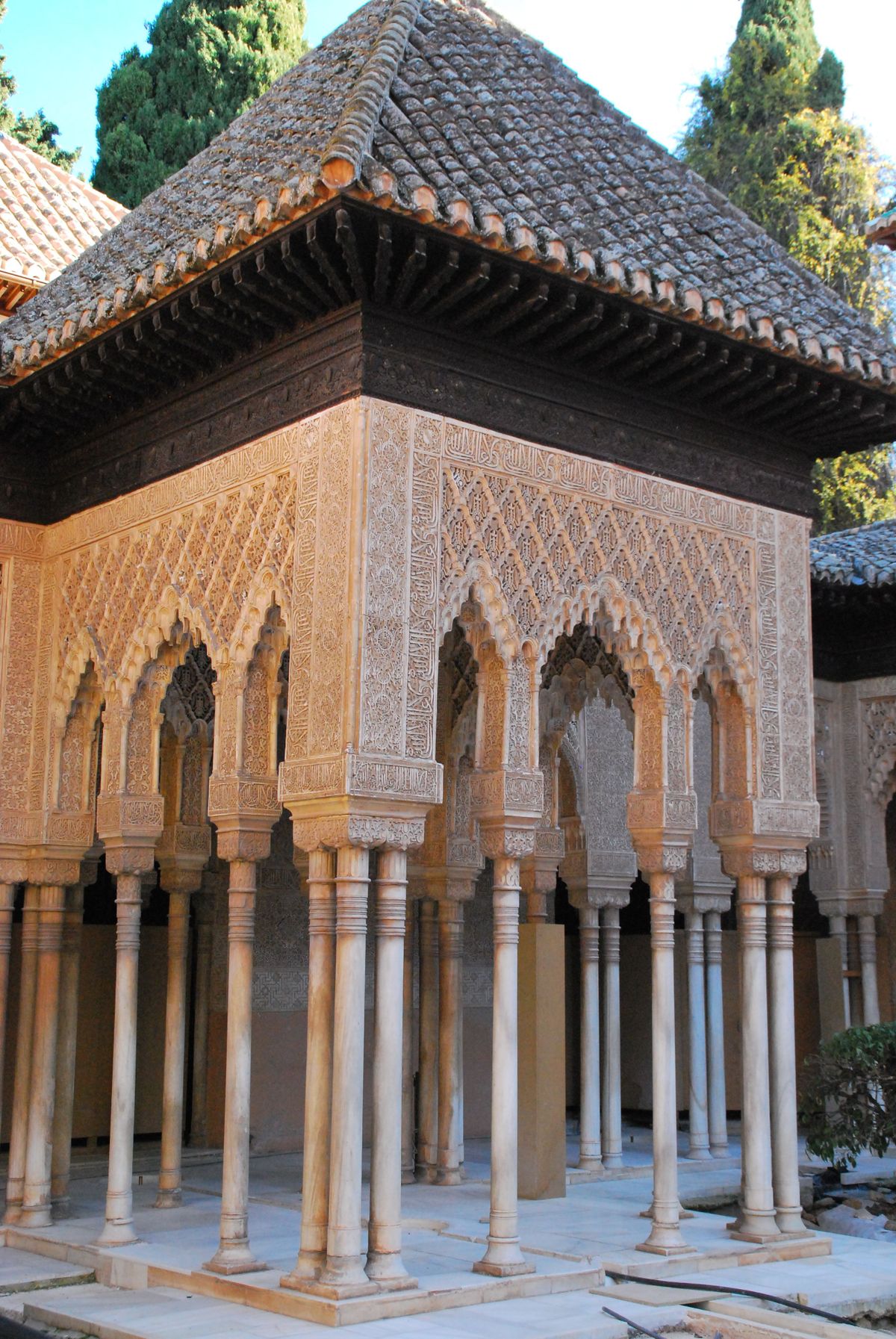
Like Rome or Lisbon, Granada also rises across seven hills. One of them is the Albaicín, the oldest inhabited part of the city.
Opposite, on the far side of the Darro River, stands the hill the Muslims called the Sabika. Its earliest settlement is uncertain but undoubtedly ancient — the Phoenicians very likely had a presence there.
At the top of this hill, flanked by the Cerro del Sol on one side and the summit of the Mauror on the other, the Arabs built the most sumptuous and exquisite monument in Hispano-Muslim architecture: qa’lat al-Hamra, the Red Castle, known the world over as the Alhambra.
Muhammad I, the Founder
The Alhambra was begun by Muhammad I (1238–1273), curiously nicknamed al-Hamar —the Red One— for the colour of his hair. He founded the Nasrid kingdom of Granada, rebuilt the old Visigothic fortress, and erected an initial palace that would become his residence.
Some claim Alhamar was drawn to the occult and had mastered alchemy, through which he obtained the immense sums needed for both his wars and his building projects.
The accusation of occultism would be levelled even more insistently at one of his successors, Yusuf I, whose works on the Alhambra were far grander — and for which he never asked his subjects for a single dirham.
Whatever the truth, such claims testify to the hermetic aura that has surrounded the Alhambra from the very start of its construction. Many scholars consider that halo intrinsic to the entire building process.
Fragility That Endures
The first impression upon entering the monument is one of incredible fragility. And it is no illusion. Although a defensive purpose may have existed at the outset, one of the most astonishing singularities of the Alhambra is precisely the delicacy of its structures.
Don’t look for walls of large ashlar stone or meticulously carved and fitted masonry here — they practically don’t exist.
The structures that rose were of rammed earth and mortar. The columns seem on the verge of snapping, the arches have almost nothing to support, the vaults look a hair’s breadth from collapsing. Everything is fragile, subtle, delicate, transient — and yet, enduring. Although the battlements crowning its walls make it look like a fortress, it is actually a palace-city that pulsed with intense and, often, highly turbulent life.
The sultan lived here, but so too did senior members of government, the soldiers of his guard, administrative staff, and a whole host of craftsmen who had their homes and workshops within the enclosure. While most Nasrid kings contributed to the construction, the Alhambra as we know it today owes its shape above all to Alhamar, his successors Yusuf I and Muhammad V —father and son— and the Emperor Charles V.
Abandonment and Restoration
Over the centuries, the Alhambra suffered vicissitudes that could well have led to its disappearance. Fortunately, after the city fell to them, the Catholic Monarchs granted it the status of Casa Real, appointed a governor, and assigned funds to repair the towers and build new access roads.
This concern was maintained by Castilian monarchs until Philip V, who abolished the governorship and seized the resources earmarked for conservation.
From the 18th century onward, neglect became almost total. The palaces, the galleries, the richest halls housed everyone from disabled soldiers to humble tradesmen, including people who did not hesitate to set up taverns in the most beautiful rooms and use the fountains as baths.
On top of this neglect came the French occupation of 1810, which turned the monument into a barracks. In 1812 the occupiers even blew up parts of it.
It would not be until 1830 that the state provided funds to begin restoration. In 1870 it was declared a National Monument, and in 1984 UNESCO named it a World Heritage Site.
Over the past century, restoration work has been intense, not only saving the Alhambra from ruin but restoring its finest image. The creation of the Patronato of the Alhambra and the Generalife guarantees that this image will endure into the future.
Frequently Asked Questions
How long does it take to visit the Alhambra?
A full visit — the Alcazaba, the Nasrid Palaces, the Generalife, and the gardens — requires three to four hours. The Nasrid Palaces have an assigned entry time on your ticket; arrive on time as access is strict.
Do I need to buy tickets in advance?
Yes. The Alhambra is the most visited monument in Spain and tickets sell out weeks ahead, especially in high season. Buy them on the official Patronato website as early as possible.
Is the night visit worth it?
A night visit to the Nasrid Palaces or the Generalife offers a completely different experience, with far fewer people and lighting that transforms the space. If you can, combine a daytime and nighttime visit.
Related Articles
- The Generalife: The Sultan’s Garden — The Nasrid leisure villa facing the Alhambra.
- Granada — Complete guide to the city and its essential corners.
- The Mosque–Cathedral of Córdoba — The other great Andalusian monument on the World Heritage list.
Find places to stay in Granada
Compare hotels, apartments, and stays with free cancellation on many bookings.