
The Mosque–Cathedral of Córdoba: The Forest of Columns
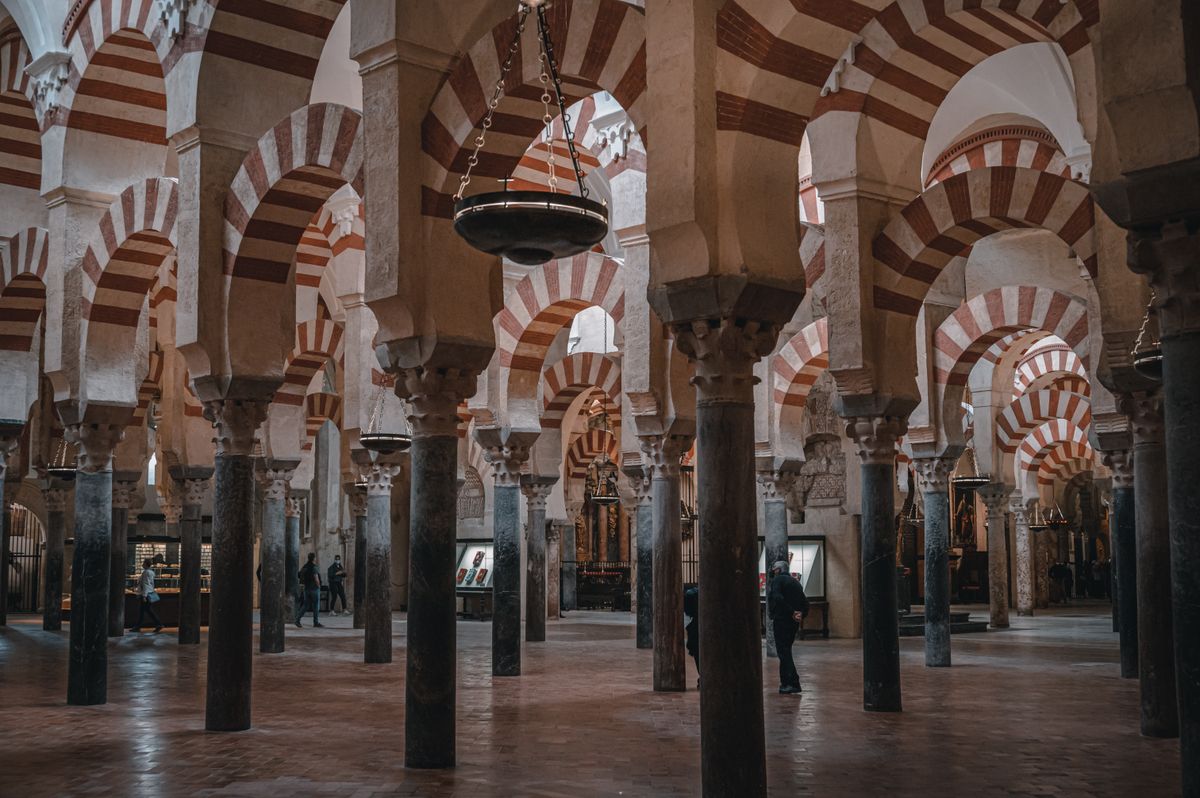
The Mosque–Cathedral of Córdoba is, alongside the Alhambra in Granada, one of the most important monuments of Andalusian architecture. At 23,500 m², it was the second largest mosque in the world after Mecca, surpassed only later by the Blue Mosque in Istanbul in 1588.
Its artistic significance was known worldwide from the moment of its construction. Over time, Christian elements were added, particularly in the 16th century when a Plateresque-style church was erected inside the forest of columns.
Eleven Centuries of Construction
Building work spanned from the 8th to the 19th century. As a result, regardless of the fact that the cathedral was built inside the mosque, the monument is a succession of different artistic styles. It is amalgam, multiplicity, and in a sense, hybrid.
In its day, the most striking feature of the mosque was its orientation. All mosques in the world are oriented towards Mecca; this one, however, faces south.
The mosque was built in rectangular sections. Emir Abd al-Rahman I ordered the first section to be raised. Successive rulers carried out further expansions until the building reached 125 metres wide by 175 metres long.
The Interior: A Sea of Columns
The first sight of the interior is overwhelming: an unfathomable sea of columns with red-and-white voussoirs and horseshoe arches of Hispano-Visigothic inspiration. Since the depth of the mosque prevented light from reaching from the courtyard, four lucernaries were built, each covered with a dome.
On the south wall is the mihrab, the small attached chapel from which the imam led the prayer. In front of it is the maqsura, its space defined by graceful interlaced horseshoe arches, decorated with arabesque carving and entwined with polylobed arches, in an incredible architectural interplay of absolute beauty.
Above these arches rise three of the lucernaries, covered with exquisite domes. The central one is the most richly decorated.
The entire ensemble features vegetal decoration — once painted in red and blue — and mosaics created by Byzantine artists sent from Constantinople by Emperor Nikephoros Phokas, who also gifted 320 hundredweights of glass-paste tesserae in various colours.
This is, without question, the area of greatest decorative richness in the entire mosque. It reaches its culmination in the mihrab, where the Byzantine mosaic work in gold and blue combines with arabesques carved in marble and gilded Kufic inscriptions.
Almanzor’s Expansion
Under Muhammad Ibn Abi Amir, Almanzor (944–1002), the caliphate of Córdoba reached its peak. The city had grown extraordinarily and the mosque had once again become too small.
Almanzor commissioned an extension on the east side, adding eight new aisles of columns. The building nearly doubled its dimensions, reaching the nineteen aisles we see today.
It’s true that the new columns no longer have the strength of the pre-existing ones, nor are the capitals as perfect or as beautiful. The colour alternation in the arches is no longer achieved with brick and stone, but with paint. Yet a single glance into the far depths of the interior is enough to discover the beauty of this new rectangle that completes the building, declared a World Cultural Heritage Site and one of the most visited places in Spain.
If you’re interested in Caliphal architecture, be sure to visit Medina Azahara, the palace-city that Abd al-Rahman III had built on the outskirts of Córdoba.
Frequently Asked Questions
What are the opening hours of the Mosque–Cathedral?
Monday to Saturday it opens from 10:00 to 19:00 (winter) and until 21:00 (summer). Sundays and bank holidays mornings only: 8:30 to 11:30 and 15:00 to 19:00. Tourist visiting hours are interrupted during liturgical services.
Can you enter for free?
Yes, admission is free Monday to Saturday from 8:30 to 9:30, but only for individual visits without a guide. This is the best slot if you want to see it without crowds.
How long do I need to see it properly?
Allow between an hour and a half and two hours. The Orange Tree Courtyard, the forest of columns, the mihrab, and the Renaissance cathedral area each need their own time. If you use an audio guide, add another half hour.
Related Articles
- Medina Azahara: A Love Story Over 1,000 Years Old — The palace-city of Abd al-Rahman III.
- Córdoba — Guide to the Caliphal city: what to see, where to eat, and how to get around.
- The Alhambra, the Red Castle — The other great Andalusian monument of Spain.
Find places to stay in Córdoba
Compare hotels, apartments, and stays with free cancellation on many bookings.