
The Triana Bridge: Uniting the Two Sevilles
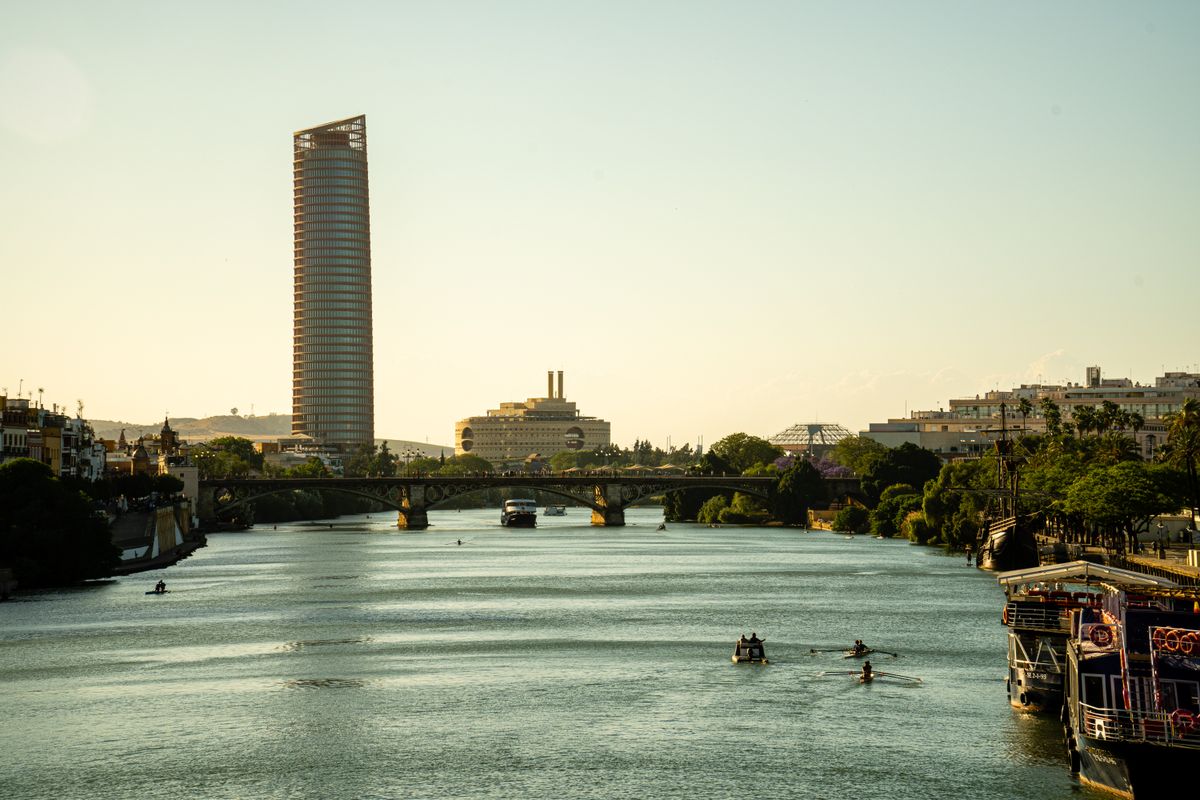
Four Minutes on Foot That Separate Two Worlds
You can’t unite what isn’t divided. But you can unite what is different. The Triana Bridge manages to do just that, because if everything is Seville, there’s something different stretching from the Maestranza to Triana, with the Guadalquivir as the backdrop, and the Triana Bridge brings them together.
There are two Sevilles: the stately, chivalrous one — the Maestranza, the strolls through the Alcázar — and a more earthy, flesh-and-blood one — Triana and its streets. The job of linking them falls to this iron bridge, which, since 1852, has defied the river’s floods with the same panache as a Triana local paying a compliment to a flowerpot.
The Bridge That Changed Seville
Until the mid-19th century, crossing the Guadalquivir between Seville and Triana meant using a bridge of boats, the famous Puente de Barcas, which was little more than a row of planks laid over moored barges. When the river rose — and the Guadalquivir has always been temperamental — the bridge was dismantled and Triana was left isolated.
The situation was untenable, and the people of Seville had been demanding a proper bridge for decades. In 1844 a public competition was held and won by two French engineers, Gustavo Steinacher and Fernando Bernadet. They designed what would become one of the first metal bridges in Spain and, for many years, the only one capable of spanning the Guadalquivir without the river swallowing it up.
Work began in 1845 and lasted seven years. On 23 February 1852, Queen Isabella II inaugurated the bridge that would bear her name. They say the celebrations were so joyful that Triana ran out of wine.
A 19th-Century Engineering Gem
The Triana Bridge, whose official name is Puente de Isabel II, is 149 metres long and rests on three wrought-iron arches fabricated at the workshops of the heirs of Elorza in Seville. Each arch weighs over 200 tonnes and is assembled with rivets, much like the hulls of the great ships of the era.
The design was inspired by the now-vanished Carrousel Bridge in Paris, and that’s no coincidence. 19th-century Seville looked very much towards France. The iron railings, the gas lamps — now electric — and the wrought-iron benches that adorn the bridge give it a Parisian air that it hasn’t lost over the years.
In 1976 it was declared a National Historic Monument, and in 1977 it was partially pedestrianised. Today, the Triana Bridge is that tricky thing to pull off: a work of engineering turned into a sentimental icon.
Crossing the Bridge: Two Worlds in Four Minutes
The walk across the bridge on foot takes barely four minutes. But those four minutes carry you from one universe to another.
On one side, the Maestranza bank: the Arenal quarter, the Torre del Oro reflected in the river, the oldest bullring in Spain, and the streets where the Sevillian aristocracy once strolled. On the other side, Triana.
Halfway across the bridge, if you stop, you’ll see the Guadalquivir opening out on either side. To the south, the San Telmo bridge and, beyond it, Los Remedios bridge. To the north, cut off by the dock, the river basin and the historic centre. And right below, on the parapet on the Triana side, there’s a viewpoint the locals call “the balcony of Triana” because from there you get the finest panorama of Seville.
Triana: A Neighbourhood with Its Own Personality
Once you cross the bridge, you’re greeted by the Plaza del Altozano. And that’s where the real journey begins. To the right, Calle Betis — or Calle Pureza, as lifelong Triana residents call it — with its colourful houses lined up along the river. To the left, the Triana Market, built over the remains of the Castle of San Jorge, which was the headquarters of the Inquisition.
The market is worth a visit even if you’re not planning to buy anything. The fish stalls are a spectacle, the fruit stalls smell of summer, and the little bars inside the market — small, noisy, and authentic — serve tapas that are pure bliss. Any of them is good. Order a glass of manzanilla, some boiled prawns, and look around you: that hubbub is Triana.
Beyond the market, Calle San Jacinto plunges you fully into the neighbourhood of potters and bullfighters, of communal houses with their flowerpot-filled courtyards, of the churches of Santa Ana and La O, of the deepest flamenco. If you want more, you can always cross back over the bridge and explore the other bank with our complete guide to Seville.
Legends of the Bridge
Like everything steeped in history in Seville, the Triana Bridge has gathered its own legends. The best-known one claims the bridge should never have been called Isabel II at all — but rather Puente de la Cava, in honour of the tragic medieval legend of La Cava Florinda that inspired so many ballads and tales.
Another story says that during the Civil War the bridge was saved from being blown up thanks to the intervention of General Queipo de Llano, who was greatly admired in Triana. The truth is that the bridge survived every war, every flood, and every attempt to modernise it.
The loveliest legend, however, is the one told by the oldest Triana locals: whoever crosses the Triana bridge on foot at sunset, with the light of Seville settling over the river, comes back to Seville sooner than they think. I don’t know if it’s true, but thousands of visitors cross it every day, and many of them do indeed return.
Frequently Asked Questions
Is the Triana Bridge open to traffic?
Yes. Although it has wide pedestrian pavements, it remains a bridge carrying traffic in both directions. The best way to enjoy it is to cross on foot, but watch out for cars, especially at rush hour.
What’s the difference between the Triana Bridge and the Isabel II Bridge?
None at all. It’s the same bridge. Isabel II has been its official name since the inauguration in 1852, but nobody in Seville calls it that. It has always been and always will be the Puente de Triana.
Can you sail beneath the bridge?
Yes. Tourist cruises along the Guadalquivir pass under the bridge and offer a different perspective, with Triana on one side and the historic centre on the other. It’s a highly recommended trip, especially at sunset.
Find places to stay in Sevilla
Compare hotels, apartments, and stays with free cancellation on many bookings.